Discourse, Distrust, and Misunderstanding

Image Source: Personal Photo

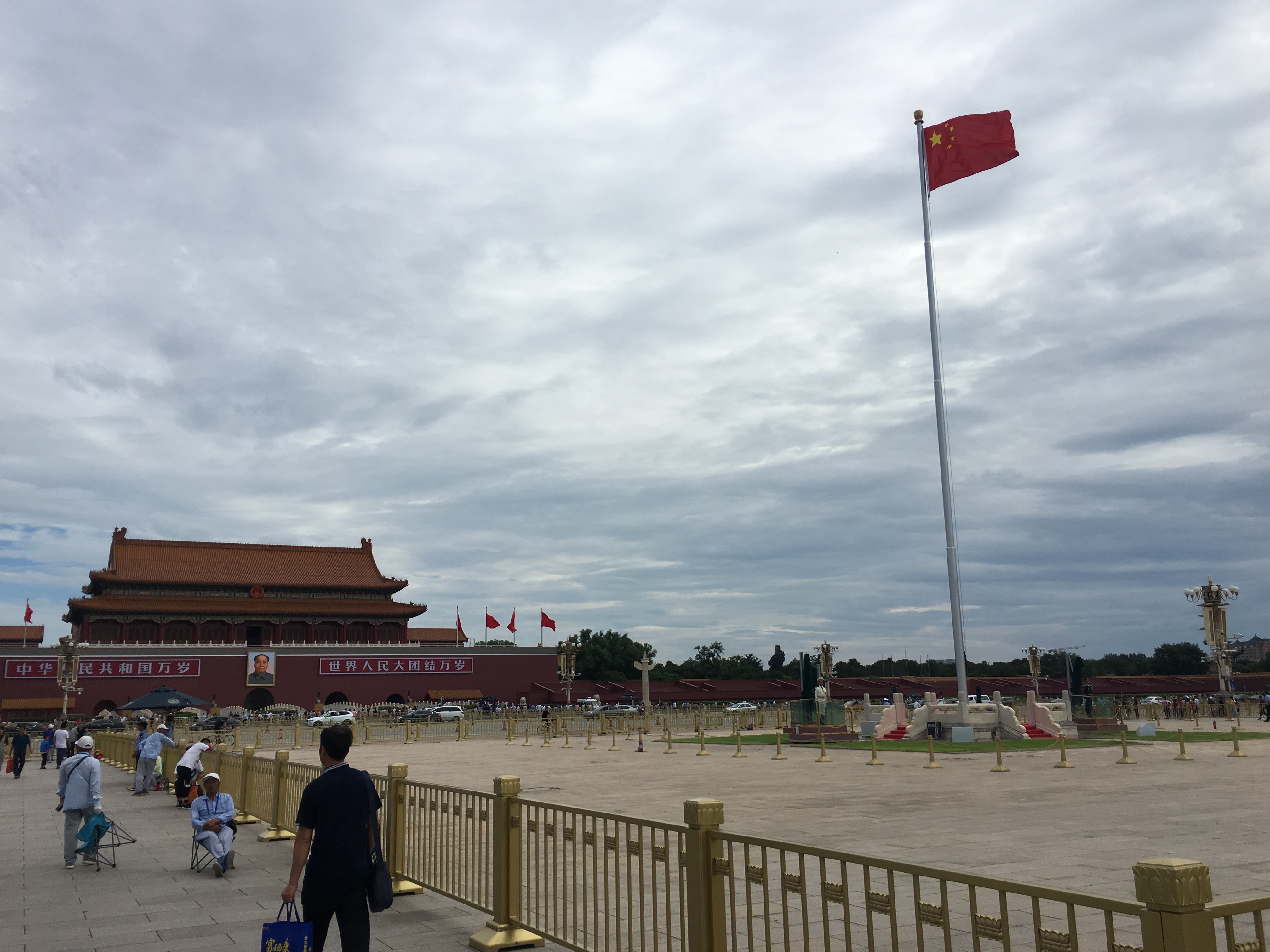
This past summer I travelled to Kunming, China to participate in a Mandarin language immersion program, which marked my first time travelling outside North America.

Months after returning to the States, I still struggle to answer the question, “How was China?” After studying for two months in China and being back in the United States for over a semester, I find myself reflecting more on the country I grew up in rather than the foreign land I just visited. 

As expected, I was entirely cut off from social media and Western news. As a chronic “news addict”, I kept up with what was happening in the world by reading state-controlled English-language media, which has a tenuous relationship with facts. Biases aside, encountering Chinese views of the world enriched my understanding of American society.

Read the full article in the 2020 Issue of the Journal of Sino-American Affairs.

It’s not about them. It’s about us.

Image Source: Pixabay.com

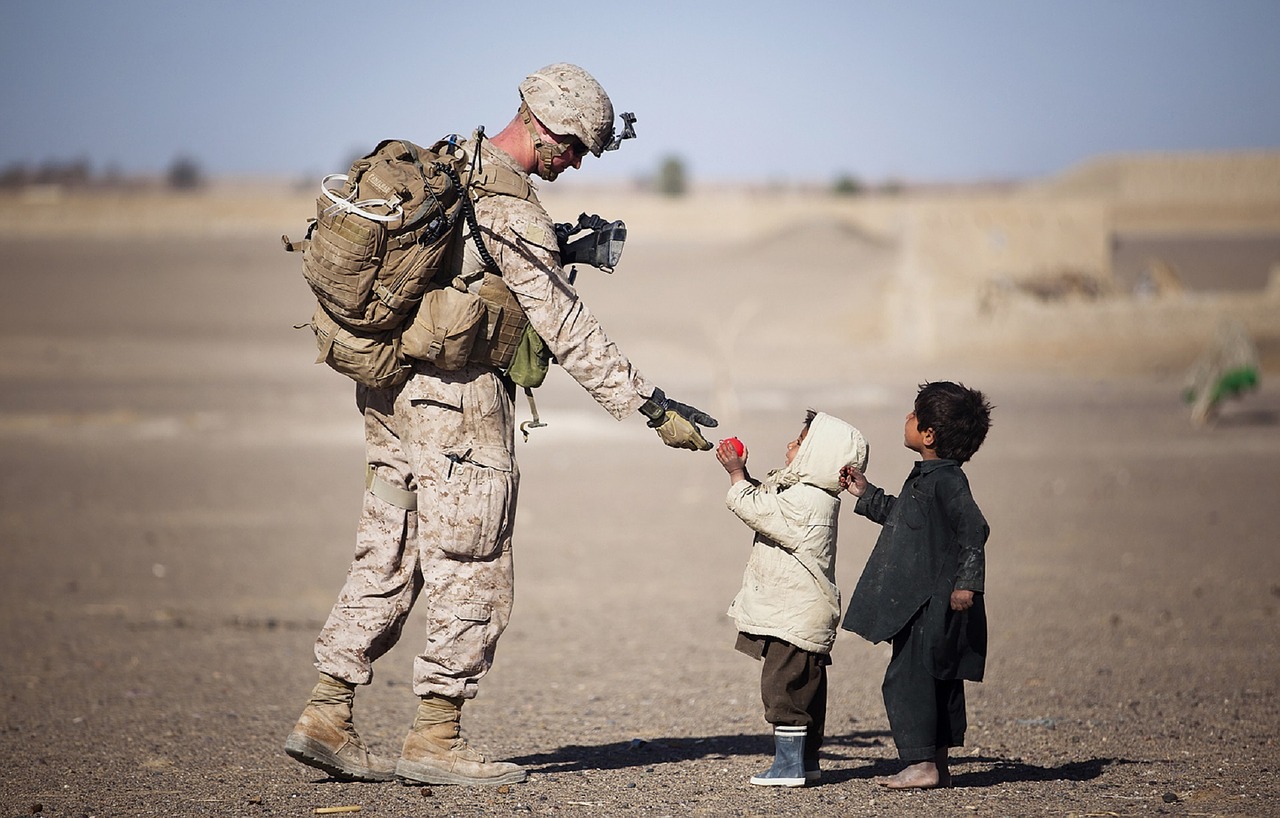
Less than 24 hours after Secretary of the Navy Richard Spencer was fired, CBS News would tape an interview with the ousted official to discuss the case of disgraced Navy SEAL Edward Gallagher. Spencer was officially fired for directly communicating the White House without knowledge of the Secretary of Defense, which could be considered a breach of the chain-of-command and a fireable offense. His dismissal came after a prolonged effort by the president to nullify Gallagher’s court-martial process; this interference threatens the legitimacy of the entire military justice system. Most presidential tweetstorms and subsequent evening news parades can be ignored as another weekly scandal; this one cannot. The undermining of American military justice is woefully misguided and a threat to national security.

Read the full article at The Texas Orator.

Why Liberals (Almost) Always Lose

Image Source: Pixabay.com

How does Justin Trudeau explain modern politics?

When I wrote one of my first articles for The Texas Orator last year on the nuances of Canadian Prime Minister Justin Trudeau, I had a vague sense of the challenges he would face moving forward. But I did not predict how those challenges would multiply before the next election. The evolution of the golden boy prime minister didn’t stop with the words I published last year; Trudeau has only grown to be more controversial with time.

As Canadians went to the polls at the end of October, recent scandals — the conflicts of interest, the legal interference, and of course, the brownface photos — were at the front of their minds. But after the election, the mixed legacy of one of the world’s most influential liberals is confronting the future of a nation that struggles with its place in the world.

Read the full article at The Texas Orator.

From Regina to Kunming: The View from a Changing China

Study Abroad is supposed to be transformative: that’s the whole point. Yet, as every stubborn college student does, I underestimated how much a couple short months would change my perspective on almost everything. These are my thoughts and reflections on a trip that was the best decision I have ever made.

Read about my travels in Tokyo, Kunming, Beijing, and Seoul in The Texas Orator.

Populist Promises and Sovereign Illusions

Image Source: Pixabay.com

“We must take our country back.” The most salient political refrain of our time is so widely endorsed that it is impossible to locate its origin. Populists from every corner of the globe all seem to share the same message, but they rarely quote each other. Their appeals to fear of subversion and to the necessity of pure autonomy have become incredibly successful in contemporary politics by building a movement around a timeless objective.

Sovereignty is an old concept in tension with a new world. The 1648 Peace of Westphalia enshrined the principle among European monarchies. For centuries, the idea that a state ought to be free from foreign interference held. When this norm has been violated – by assassinations of nobility or invasions of neighbors – massive conflicts have ensued. Even as the world democratized, the concept was transferred from the rights of the crown to the rights of the public.

Read the full article at The Texas Orator.

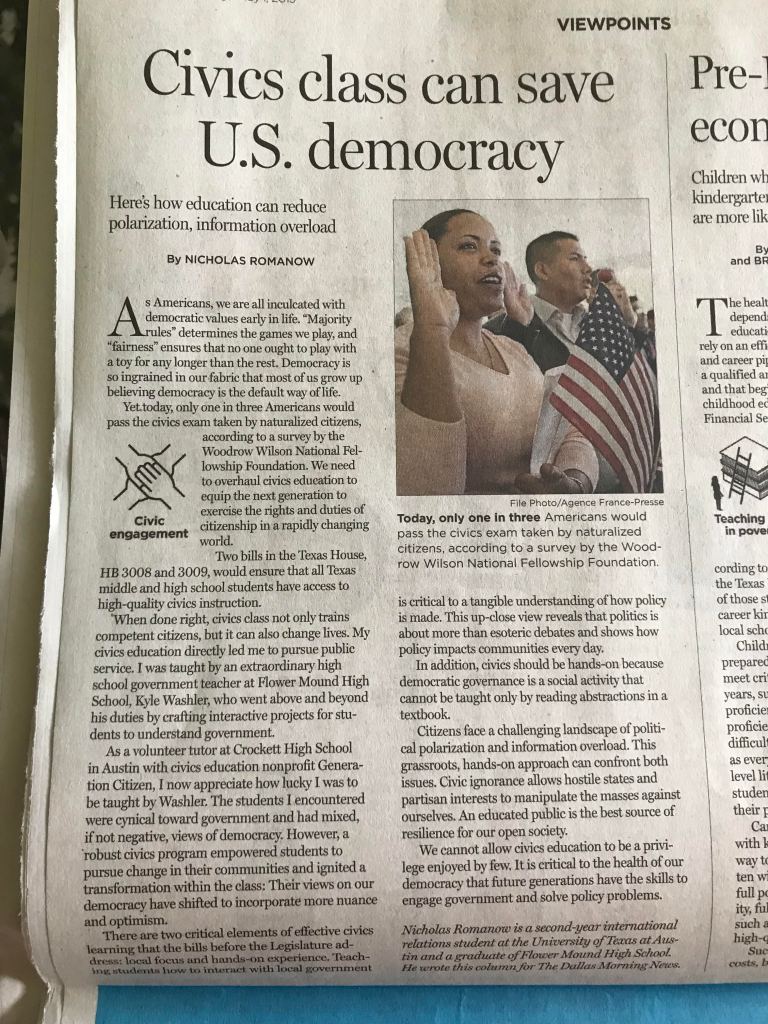
Civics class can save U.S. democracy

As Americans, we are all inculcated with democratic values early in life. “Majority rules” determines the games we play, and “fairness” ensures that no one ought to play with a toy for any longer than the rest. Democracy is so ingrained in our fabric that most of us grow up believing democracy is the default way of life.

Yet, today, only one in three Americans would pass the civics exam taken by naturalized citizens, according to a survey by the Woodrow Wilson National Fellowship Foundation. As basic notions of American society are questioned, the solution rests with we the people. We need to overhaul civics education to equip the next generation to exercise the rights and duties of citizenship in a rapidly changing world.

Read the full article at The Dallas Morning News.

Revisiting Regime Change

Another Canadian beat me – by many decades – to say that Americans are blamed and shamed far more than they deserve. In fact, Americans now constantly blame their past selves for their predicaments. Yes, unwise decisions and poorly justified convictions have occupied America’s past and will likely recur in America’s future. But Americans succumbing to self-hatred will not only hurt the United States; it will hurt the entire world.

One such popular salvo against the U.S. involves the concept of  “regime change.” Expanded to refer to either any use of the military or any action in service of democratization, “regime change” is high on the list of inner-Beltway profanities. If you want to destroy someone’s ideas, credibility, or reputation, you need only associate him or her as a supporter of “regime change.”

Read the full article at The Texas Orator.

Labelocracy: A Nation Ruled by Labels

Diagnosing what ails the American republic is a national pastime that has indicted particular culprits such as new technologyeconomic inequality, and Newt Gingrich. At the risk of adding yet another sky-is-falling tome to this burgeoning literary genre, there is another clear and present danger threatening political discourse. American politics has been afflicted by rampant reductionism, otherwise known as “Labelocracy.”

In many ways, Labelocracy is an intensified form of the scourge of identity politics. It is most clearly revealed when, as Congressman Dan Crenshaw aptly described, one entity labels “someone as an ‘-ist’ who believes in an ‘-ism’” and dismisses their statements, sentiments, and experiences altogether. Identity politics is the assertion of one’s own labels; Labelocracy is the imposition of labels onto another as a means of suffocating debate.

Read the Full Article at The Texas Orator.

A Conversation on Canada’s Forgotten Peoples

This semester, I was lucky enough to be joined at The Orator by a couple of fellow Canadians, one of which has very graciously agreed to join me in a conversation about a recurring topic in Canadian politics: First Nations issues. First Nations are what people in the States refer to as “Native American” communities; the Canadian government’s relations with these peoples is a long, often messy history, which we will try to break down and compare to Indigenous issues here in the United States. First, I want to start out by sharing our personal connections to Canadian Indigenous communities.

My family is originally from the province of Saskatchewan, which is overwhelmingly rural and sparsely populated. The Indigenous community makes up a noticeable segment of Saskatchewan. As a child, I remember visiting family and playing with Indigenous children in the park. It has only been since I left Canada that I have realized the hardships faced by generations of Indigenous peoples. I was very shocked to hear when my home province became the site of what is called “Canada’s Trayvon Martin” moment when an Indigenous man was shot and killed by a Saskatchewan farmer. These issues are always overlooked by rather rosy caricatures of Canada, so I look forward to uncovering some of the realities of this dire problem. Morgan, would you like to start off with a little introduction to your ties and background to First Nations in Canada?

Read the full article at The Texas Orator.

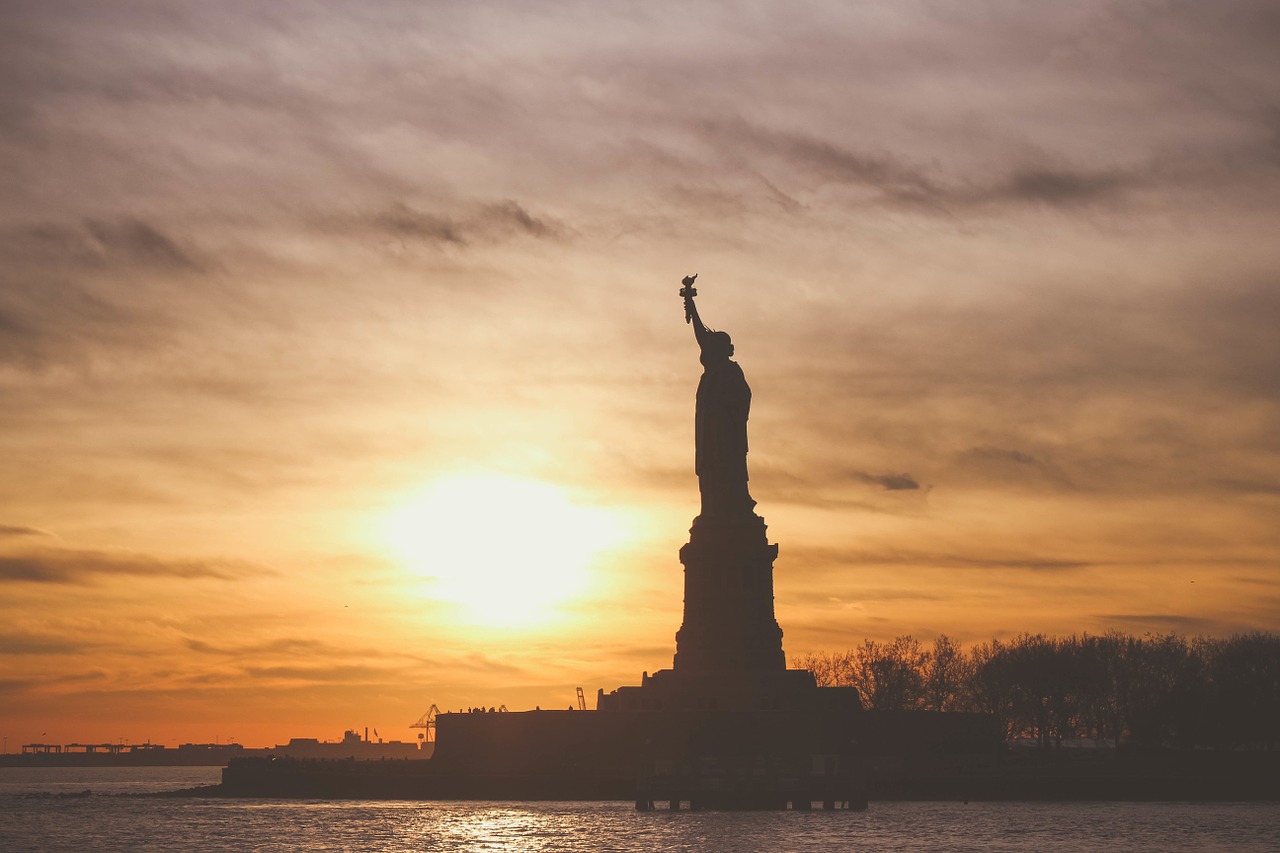
Democracy Promotion Begins at Home

statue-of-liberty-267948__180

As the polls open for early voting, the classic “I voted” stickers serve as a reminder of American civic duty, or the lack thereof. Bemoaning low voter participation is a tried and true American pastime. Yet, the most unrelenting aspect of this phenomenon is the chronic inaction by elected officials. In these midterm elections, no major candidate has made voter enfranchisement a key campaign issue. The landmark Voting Rights Act is over 50 years old, and still no recent administration has passed major federal legislation to update our elections system and address America’s consistently abysmal voter turnout.

Meanwhile, United States foreign policy sputters from one crisis to the next, unable to control a cascade of human rights calamities from Asia to the Middle East and even into Europe. For the first time in recent history, the number of democracies worldwide has begun to decline. This should be alarming. Democracies tend to avoid war against each other, build cooperative political and economic ties with other states, and are typically more stable than autocracies that rely on sustained repression. Fewer democracies in the world will threaten the longevity of our own; it’s about time we started to promote democracy here at home.

Read the full article at The Texas Orator.